
Eurasian Economic Union. The new Recommendation No. 8/2026 has come into force, introducing the Eurasian Economic Union’s (EAEU) first guidelines for the thermal mapping of medicine storage areas. This document, approved on April 20, 2026 by the Eurasian Economic Commission, establishes that temperature mapping is a mandatory requirement for the qualification of pharmaceutical warehouses. The regulations require a risk-based probe distribution, seasonal studies (summer and winter), and a minimum duration of 7 days for general warehouses.
How many sensors does the new EAEU Guide require per square meter?
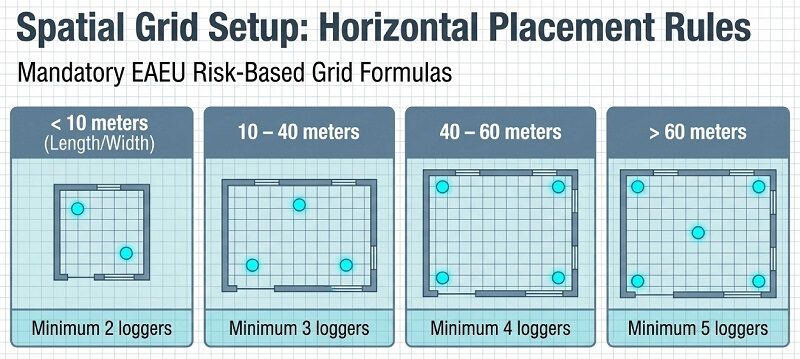
The regulation removes technical ambiguity and defines a mandatory horizontal grid. The placement must cover not only the surface area but also the critical thermal stress points identified in the Risk Analysis.
| Surface Area (Metres) | Minimum Number of Sensors (Horizontal) | Mandatory Vertical Levels |
| < 10 m | 2 sensors | Lower, Middle, and Upper |
| 10 – 40 m | 3 sensors | Lower, Middle, and Upper |
| 40 – 60 m | 4 sensors | Lower, Middle, and Upper |
| > 60 m | 5 sensors | Lower, Middle, and Upper |
Note: The lower probe must be located at the lowest storage level and the upper probe at the point of maximum load on the shelving.
Identification of Critical Points: The study must identify cold spots and hot spots, as well as areas with the greatest fluctuations. These points will determine the permanent location of the continuous monitoring probes.
How long should a thermal mapping study for EAEU GMP compliance last?
The duration of data logging must ensure that operational variability (door openings, staff traffic, HVAC cycles) is captured.
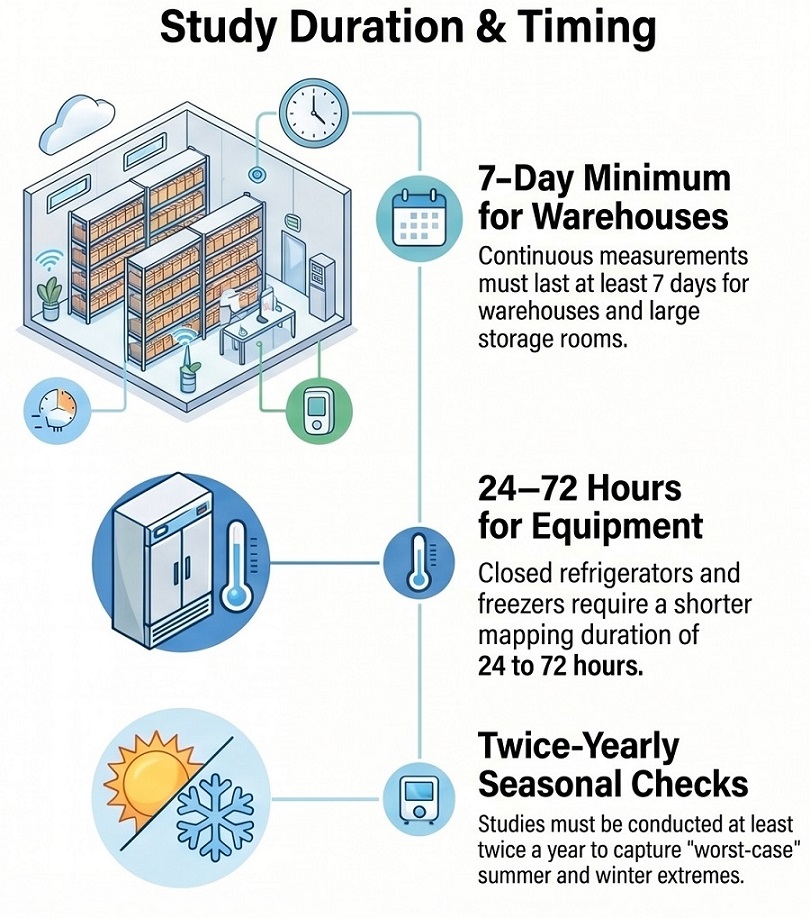
- Room-temperature or controlled-temperature storage areas: A minimum of 7 consecutive days of uninterrupted recording.
- Refrigeration equipment (chambers, freezers): Between 24 and 72 hours, depending on the demonstrated stability of the equipment.
- Load conditions: Studies must be carried out under both ‘empty’ and ‘loaded’ conditions to validate airflow behaviour.
Is requalification mandatory according to the EAEU Thermal Mapping Guide?
Yes. To meet the expectations of GMP inspectors from Russia, Belarus, Kazakhstan and Armenia, the Guide recommends that thermal mapping be carried out periodically based on risk analysis and change control. However, to confirm seasonal stability, it is advisable to carry out at least two studies per year: one in summer and another in winter. This ‘worst-case scenario’ approach ensures that the air conditioning system is capable of maintaining the required temperature range throughout the year.
- Summer Mapping: Carried out during the period of maximum external temperature.
- Winter Mapping: Carried out during the period of minimum external temperature.
- Frequency: Based on the Risk Analysis and after significant changes to the infrastructure (HVAC).
When should relative humidity control be integrated?
Humidity control is not universal, but product-specific. It is mandatory under two concurrent conditions:
- Medicines with humidity storage specifications in their marketing authorisation.
- Products whose stability may be compromised by the packaging (lack of a sufficient protective barrier).
In these cases, sensors must be combined (Temperature/Relative Humidity) and the monitoring points must coincide with the critical points identified in the thermal mapping.
Impact on EAEU GMP Certification
Failure to comply with EAEU Recommendation No. 8 will compromise EAEU GMP certification, which is obtained after passing a GMP inspection by the authorities of Russia, Kazakhstan, Belarus or Armenia. A qualification that does not strictly follow these guidelines on probe placement or study duration may result in observations that delay the granting of the EAEU GMP certificate and the export of medicines to the Eurasian Economic Union market.
At RuGMP, we provide the necessary support to ensure your laboratory successfully meets this regulatory challenge.
Expert Support for EAEU GxP Inspections
Russia · Kazakhstan · Belarus · Armenia
Mock-Inspections · Quality Audits · Training · Consulting · GMP Translator Teams